Friday, October 29, 2010

Pardon me, is that $1000 falling out of your pocket?

Yesterday, I was sick. I am still sick today, but I actually managed to get enough sleep last night (unlike the night before) that I will be doing some work from home while trying to move up my doctors appointment. It's nothing long-term serious, just sinus pressure and headaches so bad that I can't hardly keep my eyes open. Sudafed, which got the job done earlier this week, was not cutting it Wednesday night, and I woke up at 3 AM, and was awake until almost 8:30. I tried working from home, but sleep finally got me around the time I'd actually have to be productive so I bagged the day and slept. Combining that with the recent memory issues, and I'm really glad to be seeing the doctor today.

When I did wake up, and could manage to look at the computer for a little bit to alleviate some of the boredom that comes with staying home; I saw that the WTC was up to it's usual tricks. This time in the form of "Ironman Access", a program designed to allow people who evidently have more money than sense, to move to the front of the line for race signups, ahead of even volunteers and current year racers. It even included the ability to sign up for a couple of 2012 races. Why someone would want WTC to be able to hold onto their money for almost 2 years is beyond me.

With race entry fees going up each year, the every increasing difficulty for the "average triathlete" to register for the most sought after IM races due to a reduction in slots, and other more recent concerns (5150, black-out dates, etc), it was the wrong time for WTC to push for even more money. Especially as this program at least looked to the community as something that would reduce the number of entries available to the general public.

The program was so universally reviled that there was a groundswell of negative feedback on internet forums, Ironmans Facebook page, and evidently their email inbox. So swift and strong was the triathlon community response that after trying to mount a small defense via their Facebook page, WTC eventually gave in and cancelled the policy.

In announcing the change, WTC President Ben Fertic released a video that you can see here.

What really struck me about this video is how pissed off this guy looks to be making it. It made me firmly believe even more that this change was made very begrudgingly, and that this program may have even been Mr. Fertic's idea. His body language and tone are definitely not conveying any sense of sincerity whatsoever.

What hit me next is how distorted the view of the triathlon community WTC has. Their supposed motivation for this policy is according to their numbers 2500 paid for registration slots go unused each year. Talk about bending your statistics; a majority of unused slots are a result of injury, accident, and other unforeseen circumstance that prohibits the athlete from attending. Yes, there are some hard core triathletes who will register for 3 races before they fill up to be sure they get at least one of their target races, but the number of 
folks who do this do not comprise the majority of age groupers. 

In fact, this entire line of reasoning seems to contrived as a defense for instituting the Ironman Access policy to begin with. If WTC were actually worried about filling unused slots, they would institute a transfer program. Transfers are common throughout the race industry. Can't use a race entry? Simply find someone to take it off your hands, or let the race director know, and they'll find someone for you. Usually this is handled through some sort of waitlist process, which is another standard race feature WTC has chosen to completely ignore. Through a simple process similar to how TicketMaster handles the season ticket holder resale policy in other sports, you could automate the transfer process while keeping scalpers out of the loop, and making more money on transfer fees the whole time. See how screwed up WTC is? I can actually use TicketMaster (a greedy monopolistic company in its own right) as an example of good corporate practices in relation to the folks at Ironman.

In the end, the "social media uprising" against Ironman Access was successful. But it's just a matter of time before WTC comes up with yet another way to scalp a bunch of money from athletes in a way that isn't good for the average athlete or triathlon as a whole. Yet another reason that Mooseman will likely be our last WTC race.

Notes:
- I had a terrific run on Wednesday evening. I started week 5 of my Couch to 5k again, and in the first 5 minute segment, I managed to do half a mile. My second 5 minute segment was just slightly slower, but again it was fairly close to half a mile. The last 5 minutes I was a good bit slower. Sadly, I think this run is what led me on the downhill path to where I wound up just a couple hours later in terms of how I felt.

- I have a doctors appointment today, and the results of that will determine whether or not I run in tomorrows 5k. I'm feeling better today than yesterday, but I clearly have a sinus infection and I don't want to do anything that will prolong my illness. But if the doctor says it's ok, then I might give it a go.

Wednesday, October 27, 2010

Hard rowers and holy rollers

For me, this has been an offseason of trying new things. It started with my mountain biking adventure at the Landmine Classic, where I crashed and had an awesome time. Last week, Rachelle pulled me into the part of the gym where they do stuff other than cycling or running, stuff with weights and lifting things, stuff that I'm (still) not at all comfortable with. Monday night there was my first adventure with the rollers, and last night was the TRI Rowing event at the Community Rowing boathouse on the Charles River here in Boston. 

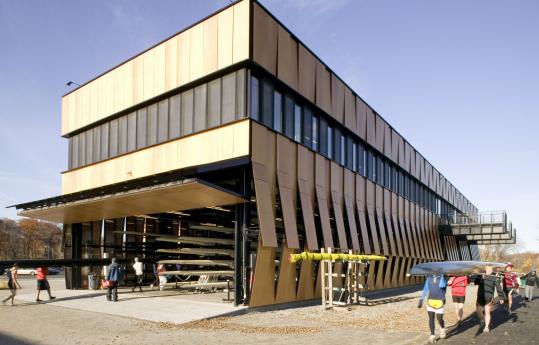
The Community Rowing Boathouse
The indoor training room is upstairs in the back of the building. The last of the 3 platforms sticking out of the second floor in the picture above is off the room we were in. The event was put on by Concept2 rowing, one of the leading companies in the rowing ergometer market (The US olympic team uses the models we used last night). The idea was to show triathletes how rowing could be beneficial for their training. If those triathletes just happened to want to buy a rowing machine later on, so much the better. Definitely not a hard sales push. 

The class was co-lead by our team captain, Sunny, who is evidently good at just about everything. She is certified on Concept2 machines, and acted essentially as our coxswain and rowing technique model. She had talked to me about the idea of rowing as part of training before this event got scheduled, so I wasn't surprised to see her heavily involved. 

The class started out with some simple slow easy rowing to get technique down. The hardest part of technique for me is keeping my knees together. i feel like the muscles inside my thighs (so groin and whatever else is in there) need to be stronger. This was always a weakness in hockey, and probably affects my running and biking as well. Everything else felt good, even my back, which surprised me because my clearly my weakest link in sports (100 extra pounds mostly in my midsection will do that).

Once everyone had the basic form down, we worked on trying to find a comfortable speed at which to row and still get a decent amount of power output. We first measured this in terms of our time per 500 meters. They explained that 26 - 28 strokes per minute is a good starting point and at that pace i was able to get down to about 1:45 seconds per 500. Of course that was going basically as hard as I could, and I couldnt sustain that pace for very long. I mostly averaged around 2:20 per 500.

Next we learned about pacing, which involved rowing intervals of increasing pace. We started at about 26 strokes per minute and worked to get over 32 strokes a minute. It doesnt seem like a big change, but it definitely felt like a big change. The instructor compared it to swimming, where you can be really efficient in getting across the water in as few strokes as possible, or you can put out less power and use more strokes, which is obviously less efficient. Finding a way to still generate a significant amount of power while doing more strokes is what separates the men from the boys, so to speak.

Then, we went for pure power. How hard could you row while keeping your strokes per minute around 28. Being the biggest guy in the room, I have an advantage is that I can really get my weight behind my pulls. We measured our power output in watts, and for a short time I was able to get my wattage up around 320, which was second best in the room. It shows that the weight helps and hurts, because getting the wattage up is great, but not being able to sustain it sucks. In the end I averaged around 300 watts, which I was fairly happy with for 3 minutes worth of rowing.

Finally, after a much needed break, the leaders divided us into 3 person teams, and we did a relay race. One ergometer, three people. The idea was that we'd row a combined 2000 m, with no one allowed to row more than 1000 m. You had to be smart during transitions, as the clock ran the whole time, even if no one was rowing. I rowed as hard as I could and did 2 segments of about  2 minutes each with my watts up over 300 for the most part. In the end, it took our team 8:30 to go 2000 m, which was about middle of the pack, I believe. And it was a lot of fun to do.

In the end, I was glad Rach and I did this, and I am definitely intrigued by the idea of rowing my way down some section of the Charles in a rowing shell. It takes a tremendous amount of energy to do it consistently, and I'm guessing even more to do it well. I'm going to add it into the gym rotations we're doing, so long as FitRec has machines that will allow it.

When I got home I was simply too beat to run, but after a long rest and a little dinner, I decided I want to try and tackle the rollers again. This time, instead of just hopping on and going for it, I devised a plan. I put the rollers up against the one flat wall in the living room and moved the couch next to the other side of the rollers so that the only way I'd wind up on the floor is if I somehow managed to take a header. 

My biggest problem on Monday night was that I just couldn't get stable enough on the bike to start pedaling properly, and then use my momentum and balance to keep going. So last night I used the wall as a crutch to get started and then once I was up and riding would move slightly to the right so as not to be touching the wall at all as I rode. I was able to do this successfully for a few minutes at a time, with just occasional bumping of the wall or leaning to avoid falling. I did take two falls onto the couch but no damage was done, and I found myself far more in control than the night before.

It's amazing how much I'm finding I need to work on balance and bike handling, but it's looking like I'll be able to gain a lot in those areas through using the rollers. I'm hoping that at some point in the near future I wont need the wall to get started on the bike so I stick the rollers in front of the TV and watch a Spinervals DVD while riding. But  even in just few minutes on the rollers, I'm finding this is definitely a good away to get in a winter workout. 

Tuesday, October 26, 2010

Jarred Shoemaker talks the talk and HELP! The rollers are trying to kill me!

Last night Rach and I went to Belmont Wheelworks for a talk featuring Jarrod Shoemaker and his coach Tim Crowley on how the training "secrets" of the pros can help the average age grouper in their efforts to improve. Mr. Shoemaker seems like a terrific guy, and is very well spoken. I feel like I learned a few things from them, and I'm going to share some of that here.

Doesn't this pic help you feel like you're getting this all first hand?
The one thing I will say up front is that I was disappointed they led off the talk about the "secrets of the pros" (insert mystical music here) with the fact that there ARE NO SECRETS! Talk about putting it all out there. If there are no secrets, what were we doing there?! (I'm kidding, of course)

Turns out, while there are no secrets there are a ton of common sense things that professionals do the same way we do. Sometimes they just do more of it, and sometimes they do it in a more sophisticated way. And there are a couple of really important ones that most age groupers probably don't do (but unlike Jarred and his coach, I'm putting the "secrets" at the bottom of the list):
  • Track your training. They track and measure almost everything. Jarrod uses power meters to capture his cycling power output, running speed, etc. They track all of that information, and have the files for the past several years. So when he says something feels different in how his training is progressing, he has the files to go back and see how that looks in terms of exertion and results.
  • Sleep. Rest is so critical for the body to get stronger and just to recover from the workouts of the day. I'm as guilty of this as anyone, with my regular nights sleep usually at about 5-6 hours. In fact, Coach Crowley indicated that it's probably worth cutting some night workouts short if it's going to deprive you of sleep because your body really needs it, and the training won't be as valuable for you without it.
  • Recovery. This ties in with sleep of course, but also using some percentage of your available training time just to spin out your legs, take a light run, or cruise at the pool. One of the quotes I took away from the night was "You can't go really fast unless you go really slow, too". It would seem from this that I am on the verge of breaking several speed records, because I have been going really slow for a REALLY long time. 
  • Speed. Speed isn't just something that shows up in races, you need to train for it. A bunch of base miles is all fine and dandy, but if you put them in slow, that's what you're going to get out of them later too. Mix in speed work all throughout your training. You don't need to do it every day, but make it a part of the longer workouts, so when you're racing and you need that burst for a pass or a strong finish, you'll have it.
And now for the two big ones I took away from the night:
  • Confidence. When you schedule a race, do that race, even if you think you're not ready for it. If you've trained, and you're healthy, do the race. You might feel like you aren't as fast as you want to be, but the training is there, and the only thing that might make you feel like you can't do it is your mind. I can attest to this one personally. Do you think I felt like I was truly ready to do Timberman when i sat there in my wetsuit for 30 minutes before my wave went off? Do it anyways. 
  • Cross training. Most of the serious age groupers I know focus very heavily on swim, bike, and run as you might expect. But one of the key points Tim and Jarrod make is that burnout can come either physically or mentally, so training in the right ways, including mixing in other disciplines can go a long way to keeping you physically and mentally fresh. Even if those other disciplines are just different forms of the same things (cyclocross was the example Jarrod used), because it's a new challenge and teaches you new skills. Plus cross training might take an extra month or so off the time you have to spend cooped up in the basement. 
It was a great hour, and to top it off Rach won a pair of the most expensive race tires Trek makes! ($75 a piece). The look on her face was priceless. It's like someone gave her a can of motor oil or something of the like. And Jarrod even posed for a picture with me, which was nice because I'd asked him a tough question about the national championship (he was the first american but came in second overall in the race to an aussie), so I'm glad he didn't beat me up. If you ever get a chance to see Mr. Shoemaker speak, i highly recommend it.

Me and Jarrod Shoemaker
Notes:

- My friend John from work has done it again. Previously he came to my aid when the bikes were stolen by giving me a nice 10 speed to ride. This time, when clearing out his basement he realized he had a set of bike rollers that were going completely unused and asked if I wanted them. With the winter looming, meaning several months on an uncomfortable bike trainer at the gym, I jumped at the chance to get these.

If you're not familiar with rollers, they're like a low-tech version of a bike trainer. 3 metal tubes connected by a frame. You put your bike on top, and start riding. While they don't offer the easy adjust-ability of a bike trainer, they provide a far more realistic feeling of riding, because you are actually rolling, just in the same place.

Therein lies the challenge: because you're actually rolling both wheels, trainers require you to use balance to ride just as you normally do, except what you're riding on is round, not flat. Here is a breakdown on my time last night:

Setting up and adjusting the rollers: 5 minutes
Time spent actually riding the bike: ~1 minute total
Time spent standing over the bike, trying to pedal with one foot, trying to get the second foot in place, pedaling for a second before losing my balance and falling off the bike, putting the bike back on the rollers and starting the process over:
about 20 minutes

So, yep, I need to work on my balance and get some practice with these suckers. I was smart enough to take the toe clips off my pedals or i probably would have broken some part of my body last night. The good news is that I worked up a sweat just trying to get this workout going, so I got some value out of the time. I'll give it another shot tomorrow, and I'm considering moving the rollers next to the bed (just in case).

- Tonight is the TRI Rowing event, where I will be physically abused in a completely different way. Hopefully tonight, I'll win the prize, so there will be no weird faces involved.

Monday, October 25, 2010

A week to look forwards to

This weekend was decidedly low key. I didn't work out after Thursday night. I started coming down with something on Friday evening, and by Sunday I had a full blown cold. We went and watched a little of the Head of the Charles regatta on Sunday afternoon. This is a can't miss event in Boston, if for nothing other than the massive amount of free healthy food samples that could fill a fridge for several days. In fact, we did just that are enjoying the benefits. Probably got 3 days worth of additional healthy snacks AND a 3 mile walk out of the deal. Plus we got to watch some great rowing.

The rest of the week will be far more up tempo with quite a lot going on.

- Tonight, we're headed to Wheelworks in order to hear US Elite National Champion Jarrod Shoemaker speak about training. He won the National Championship earlier this year, and is a MA resident. He and his coach will be sharing some of the techniques they use in Jarrod's preparation throughout the year, and how they can be applied to the average triathletes' routine.

- Tomorrow night, they're having a rowing clinic at Community Boating specifically for triathletes. The idea is to show how cross-training with an ergometer (rowing machine) can really benefit triathletes. My guess is that it's a good way to build lean muscle while burning some serious calories and that it works lots of muscle groups. As a Certified Athletic Trainer, Rach says in her experience that it's also a workout in which people are often injured, so hopefully they'll teach us the right (and safe) way to do the exercises.

- Saturday we're doing a Halloween 5k at the local YMCA just in our neighborhood. It's a bit hilly in that area, so it will be interesting to see what they have chosen for a course.

Notes:

- In what amounts to last weeks news, I lost about 1 pound on Friday. Still have a long way to go, and it's time to step on the gas. No crap food this week, and I'll be working out every day.

Friday, October 22, 2010

Look what I got in the mail, a mere 2 months late!

That's one happy guy right there!

That's right, my Timberman medal finally came! I opened it and carried it around with me until Rach got home, but I refused to put it on until she put it on me as she would have on race day. She was less than thrilled to play along with my homemade ceremony, but she was more than willing to take pictures of me acting like a fool. (She seems very excited whenever this happens).

Now that I'm officially a 70.3 finisher, I've obviously become far more distinguished, and therefore, going forward will only been seen in photos that reflect that change in status.
Winston, my good man, bring me my Chinchilla skin workout shorts
Finally, after wearing it around for a while, speaking in a British accent and making my wife roll her eyes at me multiple times, I hung that sucker up on the wall.

The nail is no longer empty
So knowing me and how fired up I get by this kind of stuff, you can only imagine how hyper I was to go work out. I went out and did the 3rd day of week 5 of my Couch ot 5k. It called for a five minute warm-up followed 20 minutes of consecutive running. 

I did a 1/2 mile in 6 minutes and had to take a short break to catch my breath. I rested for about a minute before I ran the remaining 14 minutes. The fact that I could do so much with just a little rest is a good sign, and it's clearly progress over what I've done before. But it wasn't what was called for, so I'm going to repeat week 5 of the plan. I don't consider it a failure in any way, just that I need to keep working. I wound up doing about 1 1/2 miles in 20 minutes which isnt to shabby for me. 

Rach had her spin class last night, and instead of staying home, I drove her to FitRec and got in the pool. My first "Chlorination" as a reader referred to it the other day, since the day before Club Nationals. It's amazing how fast it feels like swim fitness goes away. I didn't have nearly the stamina I did just a few weeks ago, but my speed was actually a bit better. I wound up doing around 1200 yards over an hours time, taking it real easy with breaks and building up to 250 yards in a row. A couple of weeks worth of work ought to get me back to where I was.